
The Job that Failed

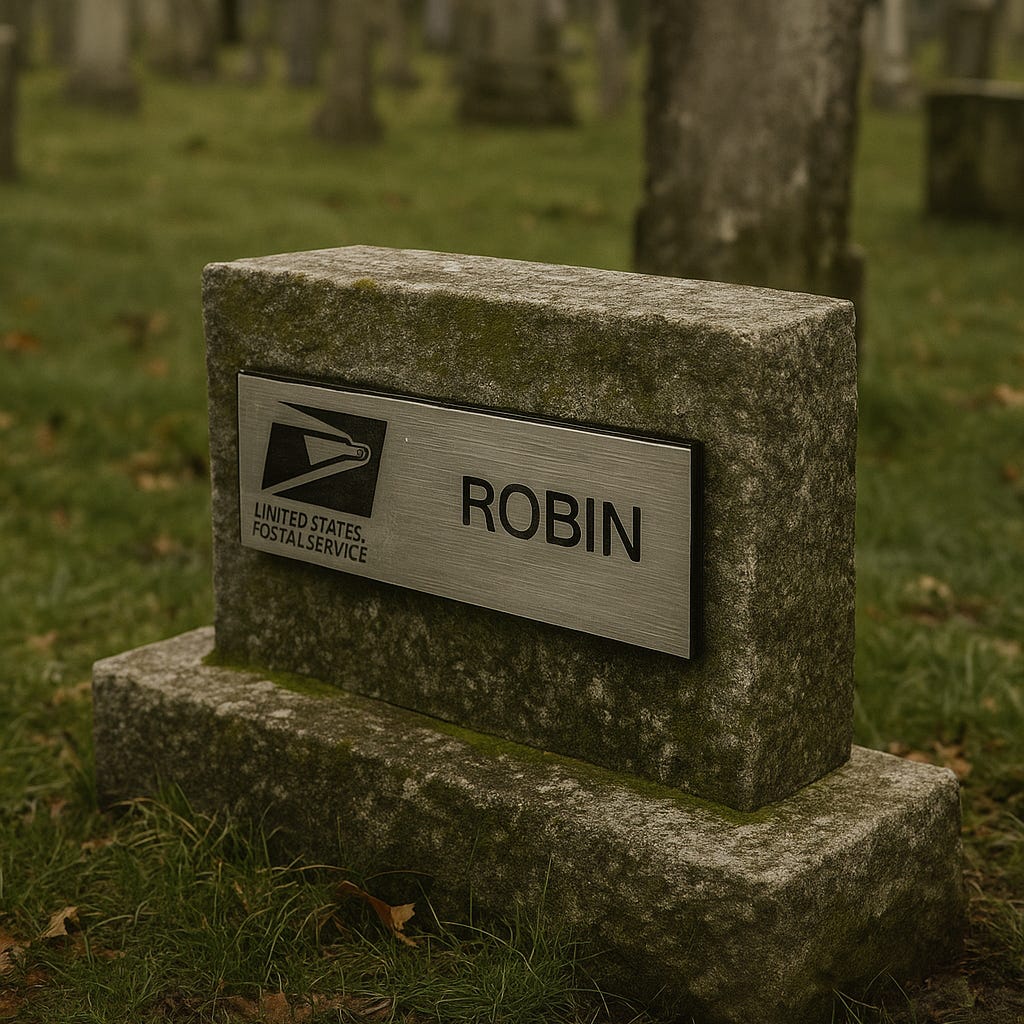
It started as more of a joke than a serious attempt get a job. My wife, Sara, saw a note somewhere that a post office in New London County (now our permanent county of residence but at the time, the location of our weekend house in the country) was looking for a part-time mail carrier who had their own car for a rural route. She envisioned me driving our Subaru down country roads, pausing every quarter mile or so to deposit a social security check in a retired farmer’s mailboxe, while listening to my ever-expanding library of fantasy fiction on Audible.com.
In 2023, after retiring from my position as executive producer at a very successful post production company after 15 years, I had expected to continue working on a freelance basis in the same bfield, whether it be producing commercials or streaming promotion videos. But to my surprise (honestly - shock) I found that the market for my talents and experience was extremely limited.
It wasn’t like I had to work. Sara was a principal at a NYC high school and while the pay wasn’t nearly commensurate with the responsibility, it wasn’t peanuts ,and besides, I had a 401-K I could (and did) burn through. But still, we had one kid in college and another one about to graduate high school, with his eyes on an $80k a year tuition, not to mention the rent on a two-bedroom apartment in Brooklyn Heights and a mortgage on our house on the water in Connecticut. Also, even though I was in my 70’s and therefore, supposedly in my golden years and ready to rest on my laurels (hah!) I was in fact someone who defined myself by what I did between the hours 9 AM and 6 PM.
To be clear, I haven’t been sitting around doing nothing since I retired. I have posted over 200 new songs to my Sound Cloud account with more on the way. I began this Substack. I learned to cook well enough to make dinner most nights for my family.
However, Sara and I knew that, for both emotional and financial reasons, I needed to find something regular to do each day. The amount of the financial reward, and the degree of emotional and ego satisfaction might not be what I was used to, but whatever I did, it wasn’t going to be forever…was it?
I tried to follow up on the this wonderful job opportunity Sara had seen but by the time I tracked down the post office job listings site, that particular position had disappeared. However, there were plenty of other carrier positions available in Connecticut. (I never considered for a moment a post office job in NYC You think I’m crazy?) I pretty quickly found a position open for a carrier in Groton CT, which is only 20 minutes away from our CT house. I filled out the online application, including the listing of personal and business references going back 20 years, and within two weeks was told I had been hired. The job would equal my Social Security check and combined with Sara’s salary and then pension, would go a long ways toward damping down the anxiety that both of us were feeling as Sara approached her own retirement.
Several weeks after I was hired, I received an email directing me to report to the New Haven Post Office for three days of training. There was nothing remarkable about the training, except that I experienced for the first time the peculiar disparity between the condition of the post office space the customer sees and the condition of the space the employees work in. Most of us have been in post offices. Aside from the main Brooklyn post office, they are clean, bright cheery spaces. However, the working spaces, the spaces where the mail is sorted, the spaces where employees spend eight or ten or twelve hours a day (and night) are pretty horrible. In the larger post offices, like New Haven, they are huge open spaces, divided by stacks of shelves creating aisles with bin after bin of mail and packages. The noise level is constant. The lighting is what I would call dirty fly-coated yellow. Everything is dusty.
After we finished the three days in-class learning, we were told to report to the Post Office parking for the driving test. And there were some whispered, half-humorous warnings about the dangers of failure due to the difficulty of backing up the hopelessly outdate USPS mail trucks.
No worries. I have been driving for many years. One of my favorite bits of autobiography has always been about how in 1972 I had backed up a large audio equipment truck with a faulty transmission 50 yards to drive 30 miles in a blizzard to pick up the Christine and John McVie of Fleetwood Mac and bring them to a concert in time for them to get on stage. I was sure passing this test would be no problem.
It was a problem. The challenge was two-fold. First, I had to back up the mail truck, using the two side mirrors, about 25 feet, and park it between four orange cones, directly behind me. Then do it again between four cones to the left of the ones behind me. I failed to do either. Several times. Repeatedly. I remember I got close one time, but it was an accident and I was unable to repeat it. I must have tried 30 times, with the instructor standing patiently next to the cones, silently shaking his head each time I finished. Lunch time came. The instructor suggested I skip lunch and practice. While the other now fully-hired trainees put on their coats and left for good, I sweated through the lunch hour backing up and driving forward, over and over. It didn’t help. If anything, I was even worse. At one point, when I was trying to back straight back, I ended up in the space next to the space I was supposed to be in. The instructor almost tearfully told me that he couldn’t pass me. He said I could take it a final time in Hartford in a couple of weeks. He suggested I practice. I vowed to myself I would pass the test. I spent the next two weeks practicing backing up. I rented a U-Haul van and backed up our long driveway over and over. When it came time to take the test again in Hartford I arrived full of confidence. The minute I got in the the truck, though, I knew it was a no-go. Sometimes you go into a difficult situation expecting magic to happen. I knew the minute I turned on the key that there wasn’t going to be any magic. If anything I did worse this time than I did in New Haven. Everyone was genuinely disappointed. I was told that, regretfully, I would not be able to accept the carrier job in Groton, and I was encouraged to apply for another position at the USPS.
Clerk positions appeared less quickly than carrier positions, and none within a 50-mile radius of Niantic. Nevertheless I continued to check daily. I expanded my reach to 75 miles and I got a hit in Rhode Island; a town called Mapleville needed a clerk. It was about an hour and and 10 minutes away on Route 395. By this point in my single-minded vision of semi-retirement, that didn’t seem like too long a drive. I filled out the application. I was hired (again).
This time, post office school was for two weeks, with no drivers’s test at the end. But it was in Providence, an hour away. No bid deal. In what turned out to be excellent preparation for the job itself, I left at 6:15 AM in order to be at the Providence Post Office in time for the beginning of class at 7:30 AM. The class was made up of seven students most of whom were already working in the post office in some other capacity. The instructor was a supervisor, a position somewhere between a clerk and and a postmaster. The instruction was by book and slide show. I felt like I was back in grade school in the 1960’s. It was all learning by rote. Memorize a fact. Memorize a series of facts. Memorize the size of box. Memorize a do. Memorize a don’t. Do a do. DON’T DO A DON’T! If you do a don’t, the walls will know, and somehow they will crash in on you.
The classes were boring but not super challenging, although I knew that there was an exam on the last day. As trivial as it now seems, I was anxious about the “final exam,” much more so than I recall being back when I took the SAT’s or even the GRE’s or the LSAT’s, all of which I took way back in the 70’s. Perhaps because of the same anxiety I felt increasingly during the driving test, and because of my advancing age I was concerned about my ability to retain all the information.
. Fortunately, I passed the final exam, and was directed to report to the Mapleville, Rhode Island Post Office the following Monday for two weeks of on-the job training, at which point I would apparently be on my own as the sole employee at this lonely outpost of the USPS.
(
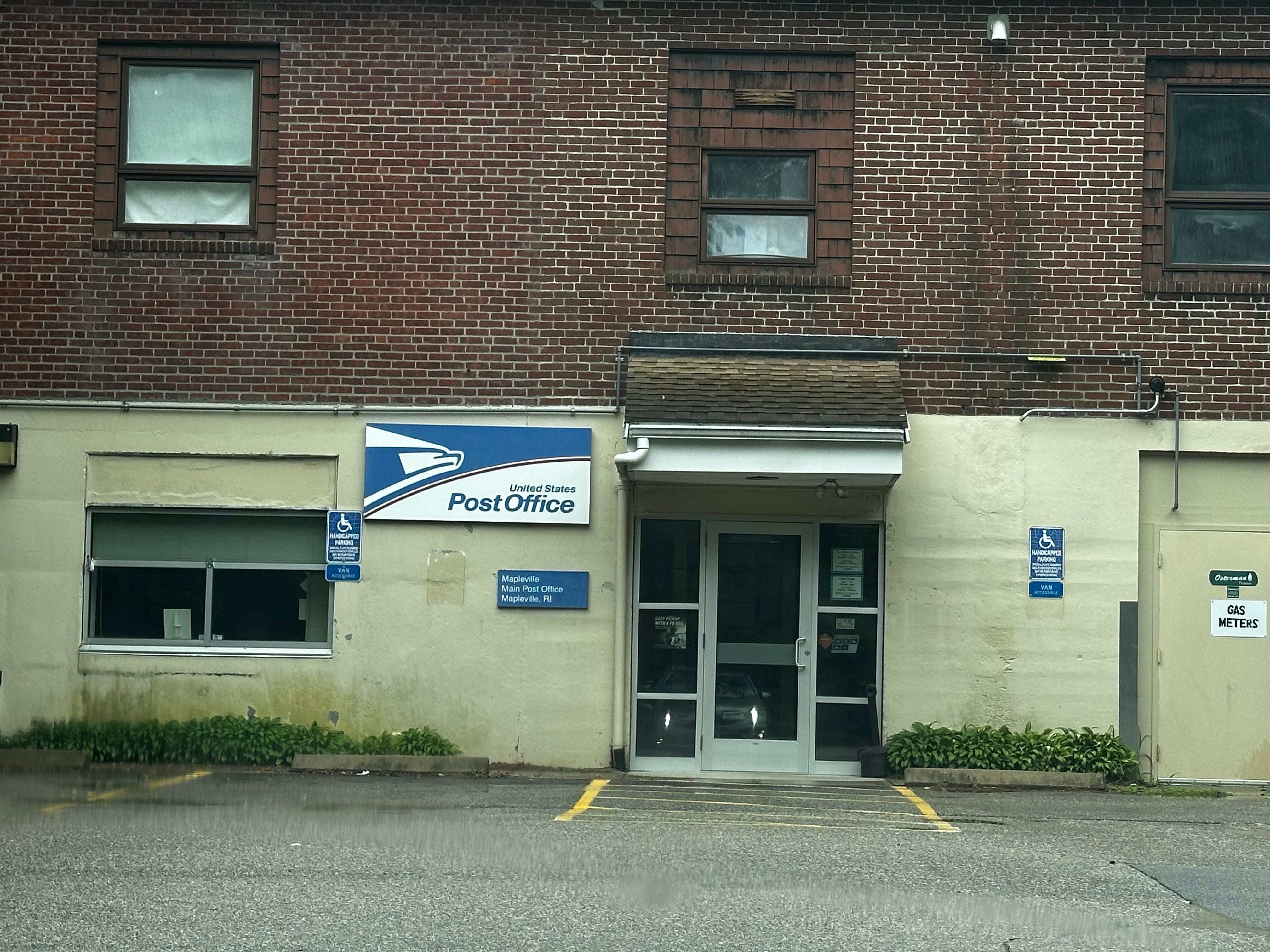
I’m still not sure how to describe Maplesville. Google Maps says “The village is home to a post office, fire station, churches, and various businesses.” There are no signs announcing you have either entered or exited the village. There didn’t seem to be a town center, unless you count to post office. (Curiously, there are two other post offices within ten minutes of Mapleville, and I never did find out why these three small towns minutes from each other required separate post offices.)
I reported for work at 8 AM on the Monday after the 4th of July weekend. The Mapleville PO was a mini version of the larger post offices in New Haven and Providence. Bright overhead lighting, yellow walls plastered with posters listing the hazardous materials that could and could not be sent through the US mails, large bins filled with undeliverable third class mail, a rickety desk holding an IBM computer and printer, a larger safe and a series of the open ends of about 100 post office boxes
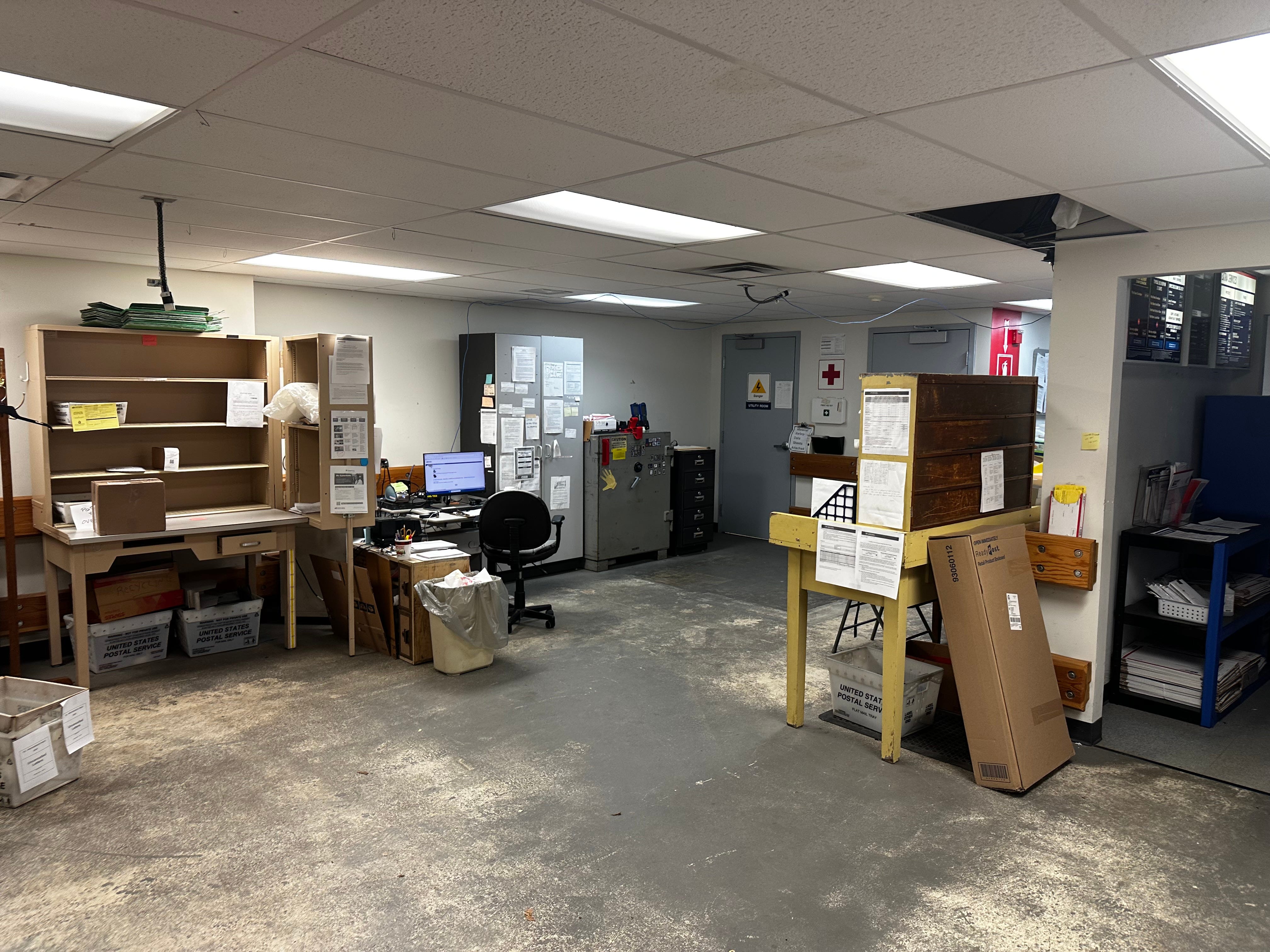
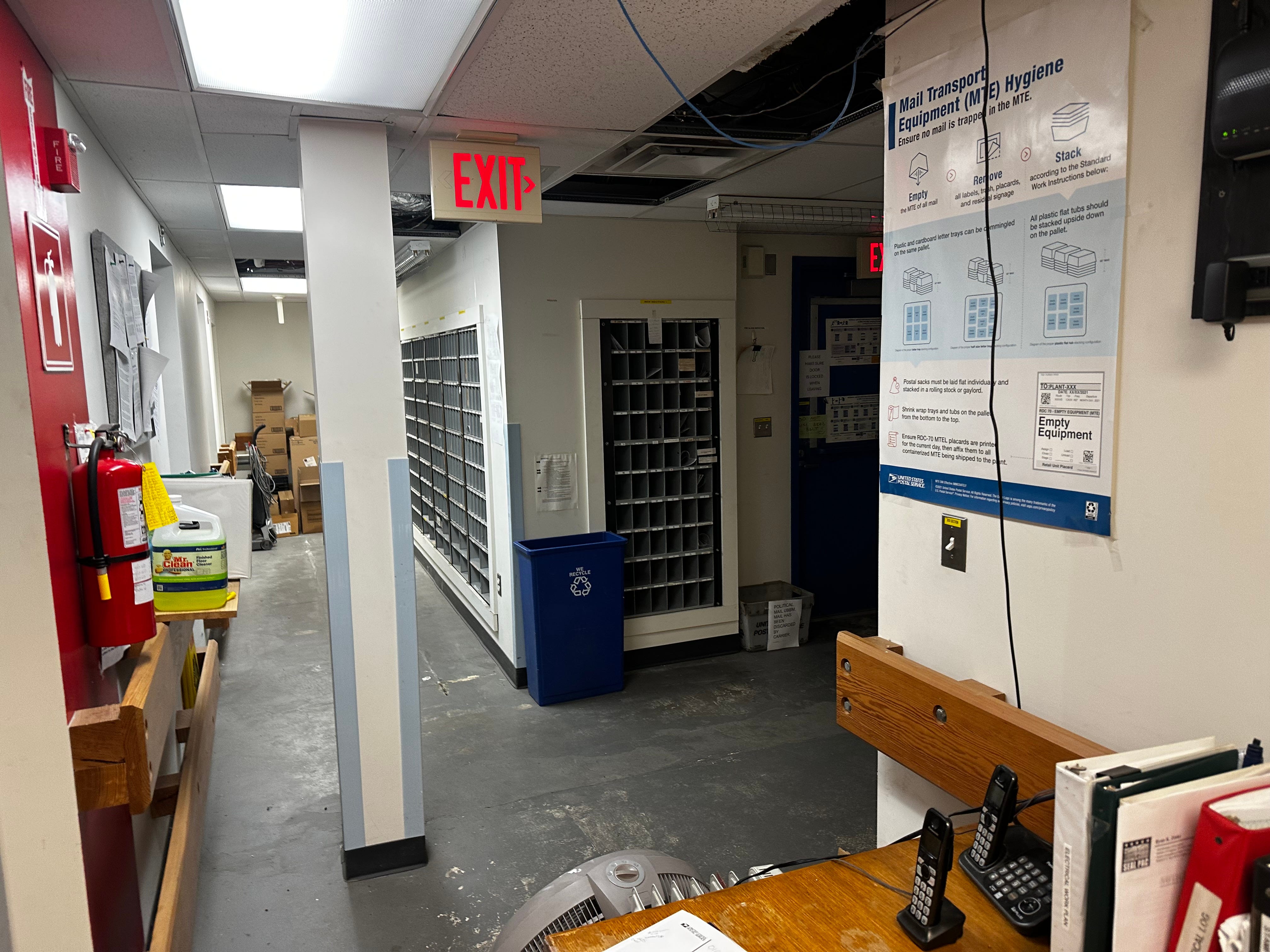
My trainer was a clerk from another post office in the area, a young smart woman who was extremely knowledgeable about the ins and outs of the arcane details of managing a small post office location.
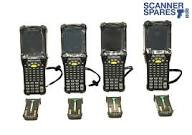
The first thing I learned was that I would not be using the more modern computerized system that we had been taught at Providence. Instead, I would be using a Motorola scanner, circa 1995, and and a mostly manual accounting system to track the money coming in and the money going out. (While everything was recorded on these outmoded scanners, the information was tabulated on different programs, which my boss seemed to be checking constantly throughout the day.)
The second thing I learned was that the post office employee’s responsibility is to perform a daily checklist of duties, starting when he or she unlocks the door. Some of these duties have to do with insuring that mail is received and processed and then dispatched in a timely manner. Most of them, however, turned out to be a series of checks to make sure the employees were fulfilling their obligations. (One computer form I had to fill out each day involved a series of questions regarding the truck from Providence that dropped off and picked up the mail each day. I had to note the time it arrived, as well as note if any mail had been left behind. Another one required me to check in three times a day, once at opening, once in the middle of the day and once at the end of the day, to confirm that everything was as it should be. There was a computer program to check the printers, a program to note the time I opened the blue box outside, a form to track who had payed the rent on their PO Box, on and on, etc.
The trainer worked with me for two weeks, trying to force feed me the information I would need to do my job successfully. I thought I was ready. I sensed a bit of hesitation in her as she wished me luck, but I was happy to be on my own.
Almost immediately, I discovered I was not good at this job. I showed up on time, I dressed correctly, I was pleasant with the customers. But for some reason, I could not get through a day of work without either forgetting to scan something, scanning at the wrong time or actually scanning something over and over because i wasn’t sure I had done it right.
My poor performance freaked me out. I have always excelled at WORK. Work has always been “what I do.” And I was used to doing it well. From 1985-2023, I was good at my job. Now, not being good almost completely paralyzed me. I seriously considered getting tested for Alzheimer’s. I( stopped eating. I slept poorly. When I closed the office, I would spend the first 30 miles on the way home going over everything, wondering if I had neglected to do something.
I don’t want to list all of the mistakes I made over the course of the first two months I worked at Mapleville. (And there were many. I’m pretty sure I did everything wrong at least once. The mistake I made that bothered me the most was forgetting to unlock the front door one morning, until someone called an hour or so after we were supposed to be open to ask why we were closed.)
Employers from the other post offices nearby (all of whom started in Mapleville) assured me that I would get it, it just took time. But when I pressed them it turned out that they all seemed to have been rolling smoothly after a couple of weeks.
As you can imagine, the quality of my work did not sit well with my boss, who was the post master for all three of the small post offices in the area. Because of the way the Post Office is set up, eventually all the mistakes I made showed up on her radar, and she was not timid about letting me know what I had done wrong. Opening my work email in the morning was always a challenge, because of the number of emails I would have waiting from my boss, detailing the errors I had made the day before. Sara called them “nastygrams,” and I got a lot of them.
I didn’t save any of the nastygrams I encountered when I opened up the computer in the morning. One that sticks in my mind was the one I received for scanning the QR code on the blue mail box at 12:28 rather than12::30. As we all know, there is a label on every blue box that tells the customer what time the mail is picked up each day. At Mapleville the mail was “picked up,” (meaning I removed the mail from the box) at 12:30. By scanning the QR code at 12:28, I caused enough of a ruckus that my boss called me at home to explain, in very simple one syllable words, but at high volume, how important it was to wait until after 12:30 to scan the blue box, and also what an idiot I was. Now I could make the excuse that no one ever told me that it had to be after 12:30. I could also point out the absurdity of getting nastygrammed for doing something two minutes earlier than I was supposed to. And while all that may be true, it was still a reminder how incompetent I was.
The more mistakes I made, the more anxious I became, and as I became more anxious the mistakes multiplied. I was in a constant state of anxiety, and in my less anxious moments, I worried that this job was killing me. Sara and I talked a lot about me quitting, but I was afraid that if I quit, I would always blame myself for not “finishing the job.” So I kept showing up. It seemed like I was never going to get it. I prayed that I could go one day without making a mistake.
At the end of July, I met with my boss for my 60-day review. As I expected, she judged my performance Unacceptable. I couldn’t argue with her. At that point I would have written the same thing. I believe she could technically have fired me at that point, but she said she was going to schedule a second review at the end of September. (I found out later that she wanted to fire me but was so short-staffed that she literally could not afford to.)
Somehow, in August I noticed that I was making fewer and fewer mistakes (helped immensely by the fact that my boss had sent over another employee to work beside me for three days.) I made it through a day without making a mistake. Then a couple of days on a row. And while that meant my anxiety level was lowering, it didn’t make the job that much more pleasant. My boss’ tone every time I called her with a question continued to be at best wary and at worst outright disgusted. For a people pleaser like me, this was hard to take.
I did start to get to know the customers, and to actually develop relationships with some of the regulars. My interactions were by far the most enjoyable part of the job. The people who came to the post office were, by and large, elderly, with time on their hands to converse, and I found that I enjoyed engaging with them, even if it was only to discuss the weather.
Ultimately, sometime in September, I decided I had to leave. At that point I felt more comfortable with my work performance, and I was getting used to the drive. I didn’t even mind (too much) the fact that I was working six days a week. And I was pretty sure that in time my boss would start trusting me. But a lot of the water under the bridge was still washing up on shore muddy and I still wasn’t relaxed enough to get a good night’s sleep. Near the end of September, after about a month of what seemed like relatively errorless work, I emailed my boss requesting two days off in November to visit my son at Oberlin on Parents’ Weekend. I had had to work the weekend we were supposed to take Conner to college, and I really wanted to see him and see the college. Her response was a quick “No.”
This was the classic last straw. Sara and I talked. I no longer felt like a failure, I was just fed up. I gave my notice at the end of September.
So ended my USPS adventure. When I tell the story now, I tell it with humor and a certain amount of humble chagrin. But I’m still wrestling with the question of why and at my age and supposedly “wise,” was I so susceptible to such bouts of anxiety? I know we live in an anxious time on a very nervous planet. Technology had created a more complicated world, and those complications only increase the anxiety. But I keep thinking that wisdom equals acceptance and equanimity. That with age I would be more willing to acknowledge my faults and quicker to forgive myself. Maybe in this case it just means I’m more attuned to my weaknesses. I would hope that the next time I go put myself in an unfamiliar situation, I’m more prepared for imperfection, and less hard on myself (because, after all, that is what generated the anxiety.) I don’t ever want to think that I would avoid challenges because of a fear of failure. But I’d also like to think that I could deal with the anxiety without letting it create more failure.
I have no regret about taking the job, Nor do I regret quitting. I look back with affection at my interactions with the customers and the other employees who helped me out. My boss and I never hit it off, but I don’t blame her for my performance. She had a tough job and neither the time nor the inclination to make it easier for me.
But I’m still shocked at the level of anxiety I felt throughout the experience, and the almost complete loss of confidence in my own competence. Confidence is a fragile thing. I would have hoped that with age I would have build some protection against that fragility. Instead it seems exactly the opposite. I’m trying to see the good in that. I want to hold on to the belief that with age comes wisdom. If that’s so, how does this marked betrayal of confidence figure into it? Anxiety is a very of-the moment emotion. For me it’s not something I can predict. Is it something that I’ve gotten better at controlling as I have (supposedly) become more aware of the insidious power anxiety holds over me. I hope so. Does that make me wiser? I don’t know.
Ironically, on my last day at the Post Office, I got an email from a friend, inviting me to work with him on a project, which is absorbing and rewarding and much less anxiety-provoking.
I also got a song out of the experience. Its called “Planets of Anxiety.”
I think it’s interesting that we might choose something in our ‘wisdom’ that is totally inappropriate for us and our strengths. (I’m thinking right now about how I should stop looking at remote job listings for jobs I would not be right for!) As the creative person you are, the excruciating detail work of this job makes me anxious just reading it! I was impressed that you tried this out and learned more about yourself but I’m glad you can go back to just being yourself!❤️
You were surprisingly--and quite productively--evenhanded, here! So interesting. I'm glad that you got better. But man that description of you backing up the truck . . . I'm still sweating.